

Why a test document
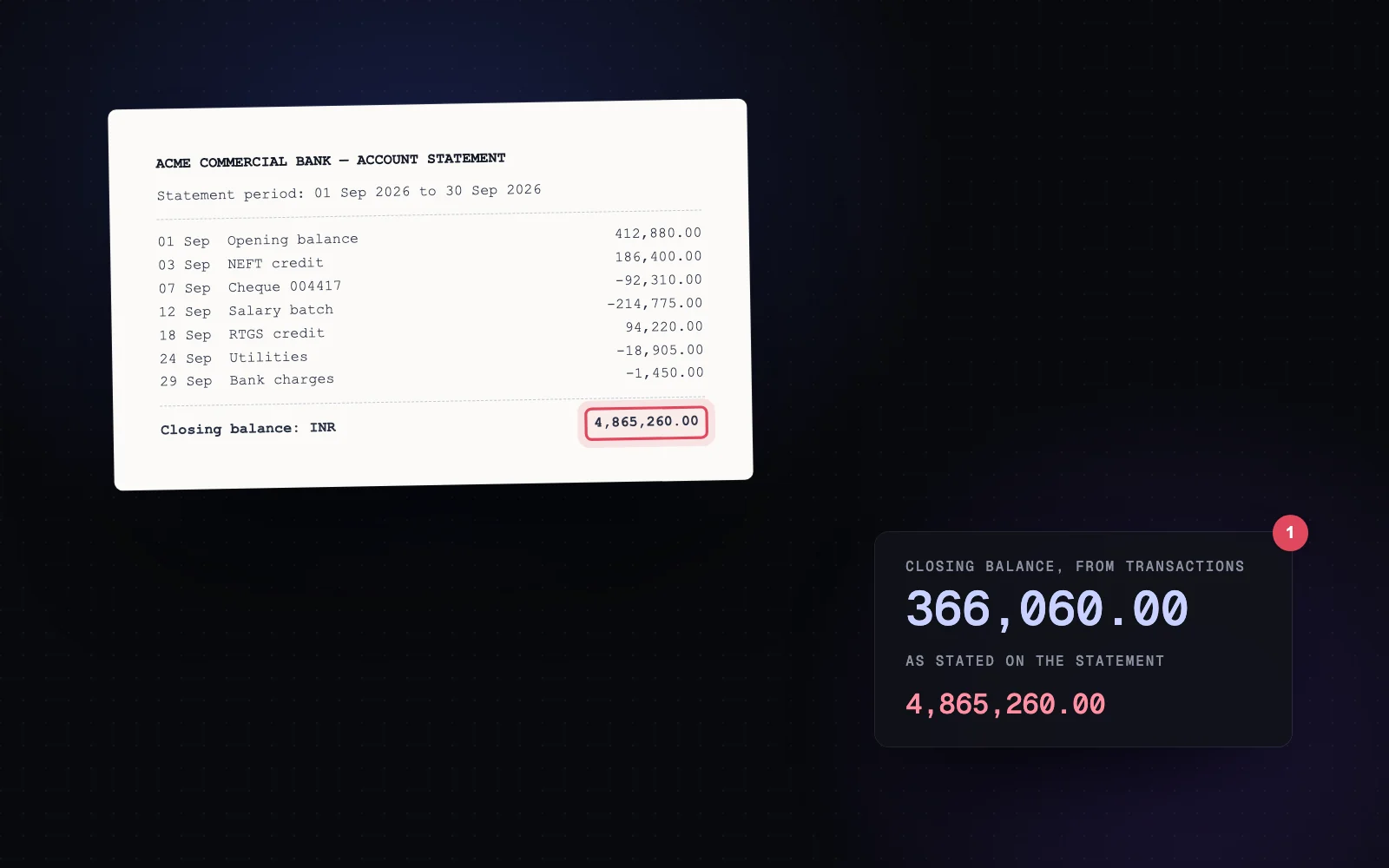
Casework documents are confidential, and the useful thing about a worked example is that the reader can check it. So this statement was built with a known answer: issued once, then opened in a PDF editor and the closing balance raised. Exiphore examined it exactly as it would a seized exhibit, and every figure below is the engine's output, not a reconstruction.
Intake and sealing
The file was hashed with SHA-256 on arrival and written to the write-once evidence locker. From that point the hash is the identity of the exhibit: the seal is re-verified before every examination, and a mismatch refuses the run.
Exiphore recognised a born-digital PDF with a text layer and ran the document checks — revision history, page against file content, typography, arithmetic and dates, structure and metadata. The photograph and video detectors were reported as not applicable, by name.
The arithmetic
The statement lists an opening balance of 412,880.00 and six transactions. Applied in order, they produce a closing balance of 366,060.00. The statement prints 4,865,260.00 — a difference of 4,499,200.00.
That finding needs nothing but the page itself, which is why it also runs on scans and phone photos. Its innocent explanation is recorded with it: a transaction missing from the extracted lines, or a sign read the wrong way, produces the same mismatch, so the figures it used are listed for checking.
What the file remembered
The PDF had been saved twice. Exiphore recovered both revisions and compared the words on the page in each. At the same position on page 1, revision 1 reads 365,260.00 and revision 2 reads 4,865,260.00 — one word removed, one added.
The first revision named a document scanner as its producer. But it held typeset text — 197 words in one embedded font — and no page images at all. A scanner produces images. The second save, written by a PDF editor, replaced the producer and removed the claim from the document's current metadata.
- Integrity · high — text changed in a later save: 365,260.00 → 4,865,260.00.
- Consistency · high — closing balance does not follow from the transactions: expected 366,060.00.
- Provenance · medium — the original claims to be a scan; it is not.
- Provenance · low — a different application wrote the later save.
The finding
Manipulation indicated, at a manipulation index of 0.84 with an interval of 0.68 to 1.00. Four findings, from three independent checks, located on the page and numbered identically in the workspace, the report, the API and the agent tools.
Examiner confidence was 54%, against a quality ceiling of 80% set by the exhibit: a small, single-page file gives the document checks less to measure than a long statement would. The report states that ceiling on its first page.
What this study is not
- The examination establishes that the statement was altered after it was first saved. It does not establish what the true balance was: that requires the bank's own ledger, and authenticity is reported as not established until it is compared.
- The revision history survived because the editor appended its save. A forger who rebuilds the file from scratch, or prints and rescans it, removes that history; the arithmetic would still have failed.
- The earlier value, 365,260.00, does not match the transactions either. The examination reports that rather than explaining it away — it may be a second alteration, or an error in the original issue.